Google Search now runs on Gemini 4 Hydrogen: what actually changes for SEO, GEO and AEO
Table of Contents
- What Google actually said
- Five changes for SEO, GEO and AEO
- 1. More sub-queries per question
- 2. More tables and images inside the answer
- 3. Hard questions go to a stronger model, and generic pages lose
- 4. llms.txt does nothing for Google
- 5. New measuring tool, new measuring calendar
- Five things to do this week
- How we apply this to our own sites
- Sources
On November 12, 2026, Google put Gemini 4 Hydrogen into Google Search for every user, worldwide. For site owners, two things change. Query fan-out gets stronger, so AI Mode splits one question into more sub-questions, searches them at the same time and links out to a wider set of sites. And answers get more visual, with more comparison tables, images and small custom tools. Google's own guidance has not moved: from its point of view, optimizing for generative AI search is "still SEO". Get indexed, publish something nobody else has, and do not count on llms.txt, because Google does not read it.
Every Google claim below was checked against the original page, linked at the end. Coverage from Search Engine Journal and Search Engine Roundtable is labeled as industry analysis. Data as of November 14, 2026.
What Google actually said
- Who and when: Robby Stein, VP of Product for Google Search, on the official Google blog, November 12. His opening line: "This is the biggest model upgrade to Search yet." Then: Hydrogen "is now available globally in Google Search for all users".
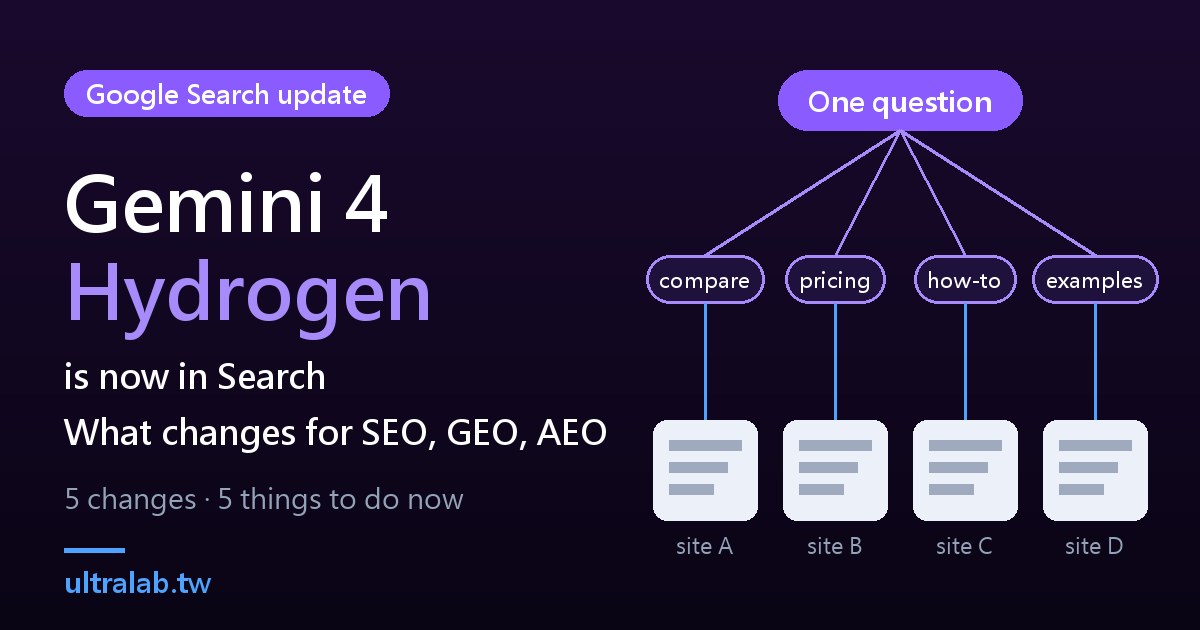
- Fan-out: "Hydrogen's advanced reasoning supercharges our query fan-out technique in Search, connecting you to a broader range of helpful links than before." The post adds that Search runs simultaneous queries across all the relevant subtopics.
- Visual answers: "You'll see more images, structured responses, comparison tables, and custom tools built for you."
- Languages: the improvements apply "across all supported AI Mode languages". We work in Traditional Chinese for Taiwan, where AI Mode has been available since October 2025, so this reaches our readers too.
- The AI Overviews line is not in the blog post. It comes from Stein on X: "It's now the new default model in AI Mode & being used for your hardest questions in AI Overviews" (as transcribed by Search Engine Roundtable). Google has not said which questions count as "hardest", a gap Search Engine Journal also called out.
Five changes for SEO, GEO and AEO
1. More sub-queries per question
What it means: Google's AI optimization guide defines query fan-out as "a set of concurrent, related queries" generated by the model. Its example: a search for "how to fix a lawn that's full of weeds" also triggers "best herbicides for lawns", "remove weeds without chemicals" and "how to prevent weeds in lawn". Hydrogen does this more thoroughly and links out more widely.
For your site: the passage that answers the main question is no longer the only way in; content that answers the sub-questions can get linked too. Whether those answers live on one page or several is up to you. The guide says Google's systems understand multiple topics on a single page, there is no ideal page length, and you do not need to chunk content. It also draws a hard line: creating separate content for every possible fan-out query, mainly to manipulate rankings or AI answers, violates Google's scaled content abuse policy, and more pages do not make a site better. Our take: what matters is whether you actually answer the follow-up questions readers have (comparisons, steps, real cases, FAQs), not how many pages you split them into.
2. More tables and images inside the answer
What it means: AI Mode will assemble comparison tables, pull in images and build small tools on the fly.
For your site: Google has not said which page formats it prefers, so this part is our judgment. If your page carries comparison data, a real HTML table with clear headers and units is easier to read correctly than a screenshot of one. On images, Google is explicit: its image SEO documentation calls alt text "The most important attribute" for image metadata. The AI optimization guide also recommends adding high-quality images and video where they make sense, since generative AI features can show them too.
3. Hard questions go to a stronger model, and generic pages lose
What it means: Per Stein on X, Hydrogen is now the AI Mode default and handles the hardest AI Overview questions. Multi-part, conditional and very specific questions get fuller answers.
For your site: a page that only restates what is already online is a page the model can write by itself. The guide calls this commodity content and gives "7 Tips for First-Time Homebuyers" as the example. Its counterexample is a first-person piece about waiving the home inspection and looking inside the sewer line. To get cited, a page needs something a model cannot generate: your test, your numbers, your case. Will clicks concentrate on fewer cited sites? Google gave no figures. Search Engine Journal notes that neither the post nor Stein's thread put a number on links or sites, so your own reports are the only evidence you will get.
4. llms.txt does nothing for Google
What it means: the first item on the guide's list of things you can ignore is llms.txt and other "special" markup: "Google Search itself doesn't use them". Creating one "will neither harm nor help your site's visibility or rankings in Google Search".
For your site: stop selling llms.txt as a way into AI Overviews. Do not delete it either. The guide says keeping it for other services or systems that use these files is "completely fine", and other AI engines and tools may still read it. The same section says you do not need special schema.org markup, do not need to chop content into chunks, do not need to rewrite for AI, and that chasing inauthentic mentions does not pay. Some of our older posts listed llms.txt in an AEO checklist. Where Google is concerned, this post supersedes them.
5. New measuring tool, new measuring calendar
What it means: Google points to one place for this: the Generative AI performance report in Search Console.
For your site: three caveats.
- Interface only. The report counts impressions, groups them by page, country, device or date, and can be exported. We hit the Search Console API on November 14: searchAnalytics accepts only web, image, video, news, discover and googleNews as the type, and every AI-related value returns a 400. We first tested this in September and nothing has changed.
- Overlap. The November 2026 core update started on November 10, and Google says it "may take up to 2 weeks". Hydrogen arrived two days in.
- A data hole. Google's data anomalies page says a logging error lowered impressions in this report for November 9 to 11.
So attribute nothing to Hydrogen until the core update is marked complete (up to two weeks, around November 24), and even then the two are tangled together. Google's core update documentation says to wait at least a full week after an update completes, then compare that week with the week before the rollout began. And being cited is not the finish line, because the answer may not say what your page says. More in Being cited by an AI Overview does not mean it said what you said.
Five things to do this week
| Action | How to check | Basis |
|---|---|---|
| 1. Cover the topic fully | Do you answer the comparisons, steps, cases and FAQs readers ask next? One page or several both work; any separate page must be one a person would actually read | Google: query fan-out; several topics on one page is fine, no ideal length; no page per fan-out query |
| 2. Put comparisons in real tables | View source and look for <table>; headers and units are explicit |
Google: answers include comparison tables. Tables over images is our judgment |
| 3. Write alt text, add video where it fits | Every meaningful image has descriptive alt text and sits next to related text | Google image SEO docs and AI optimization guide |
| 4. Publish what only you can | The page contains your own test, numbers or case | Google: non-commodity content, a unique point of view |
| 5. Make sure Google can crawl and use it | Indexed, no nosnippet, JavaScript content renders; Search generative AI under Settings in Search Console is not set to exclude | Google: indexed and eligible to show with a snippet |
Number 5 is the one people miss. Since August 31, 2026, every Search Console property has a "Search generative AI" control, and the default is to include your site. If someone switched it to exclude, your links and content stay out of these features entirely, along with the impressions and traffic. One minute to check.
How we apply this to our own sites
Ultra Lab runs three sites, and we hold them to the list above:
- MindThread (Threads automation): mindthread.tw has industry pages for lawyers, land agents and realtors in Chinese and English, plus a comparison of 10 Threads tools built as a real HTML table, where each cell carries the vendor's own wording, the source URL and the time we checked it.
- Ultra Advisor (tools for insurance agents): its tool comparison (in Chinese) lines up 7 tools in one HTML table.
- ultralab.tw: we write up what broke on us, such as scheduled tasks that report success without finishing and the night 10 Claude Code agents froze the PC. Nobody can write those without living them.
- A GEO citation baseline: every Monday we ask an AI search engine (currently Grok's web search) the same 12 questions and record which of our pages get cited. In the second round on November 9, mindthread.tw was cited on 4 questions, ultralab.tw on 4 (up from 2 in round one) and ultra-advisor.tw on 1. Next we add Google AI Mode to the same 12 questions, and we will compare only after the core update ends.
Sources
- Google blog, Robby Stein, "Google Search gets a major upgrade with Gemini 4 Hydrogen", 2026-11-12: https://blog.google/products-and-platforms/products/search/gemini-4-hydrogen-search-upgrade/
- Google Search Central, "Optimizing your website for generative AI features on Google Search" (last updated 2026-07-10): https://developers.google.com/search/docs/fundamentals/ai-optimization-guide
- Search Console Help, Generative AI performance report: https://support.google.com/webmasters/answer/16984139
- Search Console Help, Search generative AI control: https://support.google.com/webmasters/answer/16908024
- Search Console Help, data anomalies (November 9 to 11 logging error): https://support.google.com/webmasters/answer/6211453
- Google Search Status Dashboard, November 2026 core update: https://status.search.google.com/incidents/WLxcJyC6jMWMfryxsKMc
- Google Search Central, core updates: https://developers.google.com/search/docs/appearance/core-updates
- Google Search Central, image SEO: https://developers.google.com/search/docs/appearance/google-images
- Industry analysis: Search Engine Journal, Matt G. Southern, 2026-11-12: https://www.searchenginejournal.com/google-gemini-4-hydrogen-default-ai-mode/597096/
- Industry analysis: Search Engine Roundtable, Barry Schwartz, 2026-11-12: https://www.seroundtable.com/google-search-gemini-4-hydrogen-42526.html
- TechNews (Chinese), Traditional Chinese AI Mode launches in Taiwan, 2025-10-08: https://technews.tw/2025/10/08/ai-mode-is-now-available-in-taiwan/
FAQ
Is Gemini 4 Hydrogen in Google Search available in every country?
Google's announcement says Hydrogen is available globally in Google Search for all users, and that the language improvements apply across all supported AI Mode languages. The line about Hydrogen becoming the default model in AI Mode comes from Robby Stein's post on X, not from the blog post itself.
Should I still keep an llms.txt file?
Keep it if other services use it, but do not expect anything from Google. Google's AI optimization guide says Google Search ignores llms.txt, so it neither helps nor harms your visibility or rankings in Google Search. The same guide says maintaining it for other services or systems is completely fine.
Do I need special schema markup for AI Mode or AI Overviews?
No. Google's guide says structured data is not required for generative AI search and there is no special schema.org markup to add. It still recommends structured data for rich result eligibility. The real requirement is that a page is indexed and eligible to be shown in Google Search with a snippet.
How do I see whether my site shows up in AI Mode or AI Overviews?
Use the Generative AI performance report in Search Console. It counts impressions, meaning how many times links to your site were shown in generative AI features, and you can group by page, country, device or date and export the data. In our test the Search Console API does not expose it: searchAnalytics rejects AI-related type values with a 400 error, so the interface and its export button are the only way in.
My traffic moved this week. Is that Hydrogen?
You cannot tell yet. The November 2026 core update started on November 10 and Google says it may take up to two weeks; Hydrogen landed two days into it. Google also logged a data error in the Generative AI report for November 9 to 11 that lowered impressions. Google's own advice is to wait at least a full week after a core update finishes, then compare that week with the week before the update started.